Monday, June 01, 2009

Fool's Gold - Silly nonsense


One of those films that you should only watch if you really have nothing better to do. Maybe if you are trapped on a flight where there is nothing else on the flight entertainment system. Or you're with friends where after a very long and drunken lunch you collapse and the friend has the remote control. The plot is not so much formulaic as without formula at all. Take all the kids' buried treasure films you have seen. Add a modicum of racy chat hinting unsubtly at the long and hot sex that the two main protagonists have had in the past. Squeeze past the censor some gratuitous shagging in a church (well hidden behind the pews). Mix in some stereotypical baddies who seemed to have failed the audition for the latest Bond movie (one strokes a Rabbit - and is called…"Bigg Bunny). Get colourful locations with neat opportunities for some good underwater footage. Cast it with Kate Hudson who peaked early with her Oscar nomination eight years ago (for "Almost Famous") and has made dross ever since. Opposite her put Matthew McConaughey who is certainly just as pretty as she is and who has a following amongst those not too fussy about body odour. Add Donald Sutherland doing just a bit more than he needed to to pick up the cheque for his portrayal of the British rich toff with the wayward bimbo daughter (Alexis Dziena). That's about it really.


Hudson acts OK but looks rather strange. She has the opportunity to show off her very boyish figure (flat chest and neat butt) but is about as far removed from the Hollywood queens of yore as it is possible to get. Is she a Gay icon? Well she could certainly do Viola in Twelfth Night without too much need for strapping on the chest. She wins the "who has the neatest behind" contest with Dziena - but only just. Nice bikini shots of the two of them and lots of bare chest stuff from McConaughey. Something for everybody really - except students of the Cinema.
 

Thursday, January 01, 2009

Mamma Mia - the DVD

As the last strains of Waterloo eventually faded away I was to stay in my comfy chair for quite a while numb and trying to bring back to life my facility for objective criticism. What can possibly be said about Mamma Mia other than to recall Lord Reith who once said "He who prides himself on giving what he thinks the public wants is often creating a fictitious demand for low standards which he will then satisfy". That this DVD is what the public wants is not in dispute. But will this truly abysmal film now create a run on of "fictitious demand" as Hollywood rushes to copy it - well don't hold your breath.Of course objective criticism is a bit of a waste of time as those of us who think that good Cinema should at least be about films having a decent plot, well cast actors and decent production and direction may soon be in a minority. Those of us who suggest that on the evidence of the success of Mamma Mia that it is final proof of the maxim that nobody ever went broke underestimating the taste of the public are likely to be seen as elitist killjoys. Well so be it - I'm not going to dilute my crucial faculties just because the public votes with its feet and its money to crown Mamma Mia as worthwhile entertainment. Never mind the quality feel the width of the box office takings!

But, for what its worth - and that's probably not much, here is a brief list of the reasons why Mamma Mia is such excreta. The plot is trivial, unbelievable, ill-constructed, offensive and just plain dull. The casting is dire. True Meryl Streep is wonderful - but when has she ever not been? But Pierce Brosnan and Colin Firth are wooden throughout and they can't sing - and no this is not irony or even remotely funny. It's a MUSICAL. The leads must be able to sing. Doh! Amanda Seyfried can sing and she's very pretty too. But what about those bloody teeth? Sorry this may be a bit from left field but why would a nice little 20 year-old have to have shining white and 100% artificial looking brilliant white teeth. It made her look like an American Ryder Cup wife for goodness sake! Stellan Skarsgard (who?) was dull and he couldn't sing either. Julie Waters gave us one of her batty old ladies - we've seen it before Jules and it made no sense in Mamma bloody Mia. Christine Baranski was good - almost in the Streep class but surely a film with this budget could have cast all of the principals rather more thoughtfully?

The editing was woeful as well. There seemed to be a good few gaffes that should have been edited out and reshot - did nobody care or not think that we'd notice when an actor forgets their lines? And was that set meant to look realistic - or the extras look like real people? Maybe not. And maybe on stage it wouldn't matter. But it wasn't on stage - it's a movie! Musical Theatre only really transfers well to film when it is opened out. Think "Sound of Music" or "Carousel" or "My Fair Lady". Mamma Mia was claustrophobic despite the stock shots of the Aegean. It looked more like Pinewood. It was Pinewood!

OK so ABBA write catchy songs and we all like occasionally to hum along with them. But why put them into a stage show with a supposed plot in the first place. Why not just perform them as song and dance in concert? And if you must try and make a facile piece of drama around a random collection of songs and put it on stage then please don't later think that it will make a film. But you have - and a few rich people have become even richer as a result. And the Cinema is the poorer for it.

Saturday, November 15, 2008

Oliver Stone's "W." Truth that's stranger than fiction...


It is said that every President of the United States has an idiot brother (think Roger Clinton) but with George W Bush he is the idiot brother. Oliver Stone, in his fine new biopic “W.”, has decided not to exaggerate the absurdities of America’s worst ever President – he doesn’t need to. The facts are far stranger than any fiction so what Stone does is hold a mirror up to the life of Dubya – it doesn’t need to be a distorting mirror either. We see, in flashback, the hard-drinking, womanising, and idle man that Bush was for most of the first forty years of his life. We see that his father “Poppy” (Ugh!) had constantly to bail him out when he got in trouble and to use his influence to try and get the wayward son advantages, including a place at Harvard. We see the positive influence that the saintly Laura (engagingly played by Elizabeth Banks) had on him and, crucially, the born again moment when he finds God and forsakes alcohol guided by an evangelical preacher. And we see in sharp relief what is perhaps the principal theme of the film – the uneasy father/son relationship between America’s 41st and 43rd Presidents. George H.W. Bush clearly, and understandably, had scant regard for his eldest son for the first three or four decades of the latter’s life. Indeed it is on record that the Bush political dynasty was not supposed to be furthered at all by the wayward Dubya but by the more stable and reliable younger brother Jeb. George W Bush knew this, of course, and the film credibly suggests that one of his prime motivations was to prove his father wrong – first by getting elected as Governor of Texas and then more improbably as President.

In sticking with the known facts about the life of Bush Oliver Stone has not just avoided any possible libel suits but has made an even more chilling film about this accidental President. He avoids showing the accident actually happen, no Florida count stalemate, hanging chads and Supreme Court deliberations are in the film. The fact that Al Gore won a majority of the popular vote in 2000, and almost certainly won Florida as well and should have been President, is ignored – and rightly so. This is a film about the personal inadequacies of Bush, but also about his extraordinary luck. His luck in having a rich and influential father. His luck in finding a calm and tolerant wife. And especially his luck in surrounding himself with clever people who not only got him to the White House but kept him there. The fact that these clever people were mostly evil and dysfunctional was in the end Bush’s downfall but more importantly it brought the world into turmoil and the Presidency into disrepute. That Bush will leave office without a word being said in favour of anything that he did in his malignant eight years is in part a fact of Bush’s weakness and lack of fitness for high office – but it is also directly a consequence of the disastrous choices he made for his cabinet.

The malign influence of Cheney, Rumsfeld, Wolfowitz, Rice and the rest of this disreputable team is excellently shown in “W.”. Richard Dreyfuss’s Dick Cheney is a masterpiece – an impersonation so accurate and so scary that it made me feel that we can only hold our breath and hope that nothing happens before President Obama’s inauguration on 20th January 2009. Don’t count on it with this malevolent man still around! Cheney’s call for a new American imperialism with the Stars and Stripes littered across the map of the Middle East and the Caspian region was shown vividly in the movie - as was his call for American control of the massive energy resources of this part of the world. If there were still any doubters around that the grab for oil and gas was a prime driver of the Iraq invasion in 2003 and of the so-called “war on terror” then Cheney’s chilling Power Point presentation on the subject in W. will have silenced any such doubts.

The portrayal in W. of two people at the two ends of the moral spectrum was crucial to the story – and to the unfolding of the disaster that was George Bush’s presidency. Early in his emerging career as a politician Dubya was spotted and adopted by the Machiavellian and ruthless and connivingly clever Karl Rove. Rove was as smart as Dubya was dumb and we see this both from the way that Rove gave Bush the words and the bullets and how Bush blustered and stuttered when Rove wasn’t around directly to pull the strings – most memorably in a press conference in April 2004. Bush is asked what lessons he had taken away from events since the Sept. 11 attacks. He shakes his head, looks quizzical and then says: “I’m sure something will pop into my head here in the midst of this press conference, all the pressure of trying to come up with an answer, but it hasn’t yet.” Oliver Stone didn’t invent this – he didn’t need to. He just told it as it was – and the portrayal of Rove by the brilliant English actor Toby Jones is masterly.

The second of the two crucial characters, and in many ways the antithesis of the vile Rove, was Colin Powell who comes out of the movie with his reputation intact, except for his failure to stick to his obviously deep-felt (and right) view that the invasion or Iraq was both morally and militarily wrong. Powell knew that the justification for the war, the mythical “Weapons of Mass Destruction”, was specious. He also knew that whilst toppling Saddam would be a military cakewalk managing the post invasion world would be both dangerous and difficult. Unfortunately Powell acted not as the calming and intellectually robust Secretary of State that he could have been but as the über-loyal ex General that he was as well. Whilst he must have felt scant respect for the idiotic and ignorant gung-ho imperatives of his Commander-in Chief in the end his ingrained military loyalty made him hold his tongue. And the rest is history.


The damage that George W Bush has done to America’s reputation and the cataclysmic after-effects of his being in thrall to the neo-conservatives pulling his strings will probably not be banished for the first couple of years of Barack Obama’s presidency, but once again there is hope that a firm moral purpose will return to the governance of the United States of America. The Bush years will be seen as a malignant blot on the good name of America – and Oliver Stones’ excellent movie “W.” will help future generations understand why it all happened. Essential viewing for all.

Tuesday, November 11, 2008

The joy of the dance...

One of the extraordinary appeals of dance is that it is, by definition, non verbal – it transcends language in a way that is unique. Some music does this as well, of course, but whilst a Symphony concert can be ravishing to the ears dance appeals to all of the senses in a deeply emotional way. I remember, at a time of some stress, how the work of the wonderful Nederlands Dans Theatre in The Hague under their brilliant choreographer Jiří Kylián was an inspiration to me. I was struggling with learning the Dutch language at the time (don’t ask!) and to be in an environment where everything was communicated through movement rather than verbally was a blessed release!
In the last couple of weeks I have since dance at two ends of the dance continuum from classical to modern. The new production of Jerome Robbins groundbreaking dance musical West Side Story has been on in London – and very fine it is as well. The music and the book of this great American musical are so powerful that it is sometimes easy to overlook that the main originator was actually Robbins, a choreographer of exceptional originality and quality, and that dance is central to the piece. West Side Story is of course a narrative and the dance carries the narrative along just as much as the songs and the other action. Robbins choreography is hard to categorise. Unlike the ballet sequences in, say, Carousel or Oklahoma which, fine though they can be, are really incidental to the plot in West Side Story the dance is central. It is largely ensemble dance with quite strong balletic influences, although unequivocally modern. Wonderful!


My second recent dance experience was at London's Royal Ballet where a three act programme in which two George Balanchine ballets to Tchaikovsky sandwich the extraordinary “L’Invitation au voyage” by Michael Corder to music by Henri Duparc. The impressive thing about Corder’s work, which was first seen in 1982 and has been revived for this programme, is that the dance is to a song cycle – wonderfully performed by the Mezzo-Soprano Harriet Williams. The staging is superb – I found the costumes and sets almost surreal and Daliesque. The two Balanchine pieces are just ravishing in every way – the music, the costumes and the richness of the movement are sublime. They are also, I though, quite passionate and arousing pieces - even though there is no real semblance of a storyline. As Havelock Ellis (who knew a thing or two about arousal) said "Dancing is the loftiest, the most moving, the most beautiful of the arts, because it is no mere translation or abstraction from life; it is life itself"

Monday, November 03, 2008

The Upper Middle classes at play...


This is a hugely impressive debut by writer/director Joanna Hogg. It is an uncomfortably realistic film in that you feel at times that you are being a voyeur and eavesdropper at real events. That the characters are so realistic is a tribute to Hogg’s skills and to the quality of the actors. In that respect I was reminded of Mike Leigh who also makes movies that really do seem to intrude upon and depict the real world. In a sense, of course, not all of us go to see movies to see life at its most real and (in this case) in the raw. There is nothing escapist or improbable about the unfolding of events in Unrelated nor are any of the characters unlikely depictions either. More’s the pity for a more ghastly bunch of arrogant, insular, selfish sons and daughters of privilege it would be hard to find. Not too hard actually in honesty for this type of English man and woman is all too commonly seen in the leafy suburbs and the Tory Blue counties. Here they are summering in Tuscany with a holiday lifestyle as empty as it is privileged. So empty that they resort to infantile games to pass the time between meals and indulge in banter that suggests that they have libraries in inverse proportion to their wealth – which is considerable.

There are two main themes. First the battle between the “olds” the forty-something adults and the younger set in their late teens. Key conflict is that between George, a prosperous prat with a high regard for himself and a low regard for his son Oakley with whom he has an alpha-male contest. The second theme is that of the lonely, confused and menopausal visitor Anna and how she relates as something of an outsider to the rest of the party. She is going through a crisis with her husband who was supposed to accompany her to Italy but who in the end stays at home. Does she want to leave him, he her or do they both want a new start or to “try again”? The unfolding of this happens as we listen in to one side, Anna’s, of a series of stressed mobile phone conversations. Anna is clearly something of a “poor relation” to the main characters who are wealthier and for self-assured than she is – albeit in a repulsively conceited way. This applies especially to Oakley who is attractive in a pre-Raphaelite sort of way and for whom Anna quite soon has urges – not withstanding the full generation gap in age between them. There is a trip to Sienna during which Anna certainly flirts self-consciously with Oakley and maybe he with her – we cannot be sure of his motives, until later.

Joanna Hogg films the whole story in a cleverly under-stated way. Even the lovely Tuscany countryside and the beauties of Sienna are toned down by the use of a gentle filter – at no time are we in a travelogue in “Unrelated”. The climax of the film is an event which could have been serious, but actually wasn’t. When George works out what happened in this event he blows his top in an overemotional way with Oakley who he blames for what occurred. It is a pretty nasty scene which we hear but do not see - a very clever device that further enhances the verisimilitude.

Is “Unrelated” a film with a “cause” to promote? Probably not unless it is to confirm that at its most supercilious and uncaring man’s nature is pretty malicious. We know that before we see the film of course, but what the film succeeds in doing is to show that a group of people who would probably regard themselves as being educated and enlightened are in fact hypocritical, selfish and irredeemably self-centred – especially in their treatment of their visitor who is subjected to the minimum of courtesy and the maximum of patronising contempt. Anna is the only character we care about and we do feel sorry for her – and there is some satisfaction that at the end of the film it is she, after the revelation about what has caused her current melancholy, looks to have some resolution in her life. And the rest of the party move on, no doubt unaware of Anna’s turmoil, and back to a world at home in leafy England where they can parade and pomp about how “heavenly” Tuscany was again.

Thursday, October 16, 2008

A better than it might have been Brideshead


The practising of the art of transferring great works of literature or drama into other media such as film or television is always likely to be controversial or divisive. Even when it is done supremely well, as when Evelyn Waugh’s 1945 novel “Brideshead Revisited” became an eleven-hour TV epic in 1981, not every lover of the original was happy. And now, in a world that is as different from 1981 as 1981 was from 1945, we have the movie of the book – and reverential critics have not just the literature to compare it with but also the hugely admired TV series as well. And the film, in the eyes of most reviewers, is not a patch on the series and for some it is a travesty of the book as well. I beg to differ.

I don’t think that Julian Jarrold’s Brideshead is a great film or even, perhaps, a very good one. But it isn’t as bad as many of the reviewers have opined. It is beautifully filmed – surely some prize for cinematography for Jess Hall would be in order. The script is also pretty good – Andrew Davies and Jeremy Brock have wisely stuck with Waugh’s original as far as possible. The story is well told and whilst a few liberties have been taken, some quite unnecessary, nothing too much is left out – quite a masterpiece of compression.

The casting is competent rather inspired with one or two exceptions. I thought that Ben Whishaw’s Sebastian Flyte worked surprisingly well. He wasn’t very pretty in a convectional way (as Anthony Andrews undoubtedly had been in the TV series) but he was quite beguiling – and , crucially, he looked like a gay alcoholic almost from the start. He didn’t gradually descend into alcoholism but he revealed these tendencies from the beginning – which I think was right. He also looked like his sister Julia, played by Hayley Atwell and they were credible as siblings for this reason alone. Hayley Atwell was enchanting – although quite a modern Julia I thought. But the scene when she goes swimming in the Lido in Venice showed her charms off well – and Charles Ryder clearly thought so to.

The trouble with the Venice segment is that it stayed from Waugh completely. Julia never went to Venice at the same time as Charles in the book and it is quite unnecessary for her to do so (looking good in a bathing costume is insufficient reason). What this irritating scene did was to suggest a far stronger ménage a trios than is apparent in the book. Charles came much more slowly to succumb to Julia’s charms in Waugh’s original and to portray it as otherwise was a cheap shot and silly. Similarly when you compress a long and complex novel into a little over two hours why invent new scenes – the Crnival was well filmed, but it isn’t in the book and it was gratuitous?

I enjoyed Matthew Goode’s Charles Ryder very much – it was a close imitation of Jeremy Irons and none the worse for that. But he should have had a moustache in the Army scenes – every officer did at the time and he looked odd without one!

But what about the religion? After reading the book you will wonder why Evelyn Waugh became a Catholic convert. After seeing the film you will think that he must have been certifiable to do so. Charles Ryder also follows the Waugh conversion to Catholic path and there is no logic in the film to this whatsoever. Catholicism in the Marchmain family
version is an evil doctrine that screws up marriages, relationships, families, people and lives. Why the hell would Charles Ryder want anything to do with this gruesome faith? He rails against the phoney hypocrisy at Lord Marchmain’s deathbed – his atheist stance seems incontestable at the time. So why would he move to Rome later as Waugh makes clear that he does. The film cannot and does not explain.

Emma Thompson is superb as the ghastly Lady Marchmain and Michael Gambon equally as good as her estranged husband. Indeed I cannot really fault any of the performances and they do not fail to measure up to the equally fine acting in the TV series of 1981.

Did I enjoy the movie? Yes I think that I did and I didn’t really expect to. The book is my favourite novel of all – so I am likely to be a harsh critic. I didn’t like the messing around with the plot, but in the main it was true to the original. If as a result of seeing the film many people go out and read the book for the first time (I hope they do) then it will have achieved something worthwhile.

Sunday, August 10, 2008

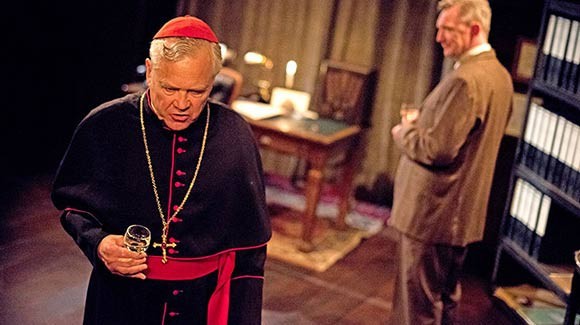
The History Boys


The play blends comedy with tragedy and has many layers and themes. Whilst the story is ostensibly about education and, in particular, the teaching of talented pupils on the cusp of adulthood it is also a subtle study of the human and personal relationships between teacher and pupil, pupil and pupil and teacher and teacher. Hector, the confident but eccentric, eclectic and iconoclastic history teacher is contrasted with Irwin, a generation younger than him, who is clever, confused and insecure. The boys have warmed to Hector's maverick style and methods which includes role playing and a very broad cultural range - from Gracie Fields to Housman. They tolerate Hector's fondness for fondling their genitalia when on his motor bike with equanimity clearly seeing it as a harmless foible rather than a pederastic threat.

The boys themselves are sharply contrasted and skilfully characterised. Dakin, is handsome and self-confident attracting not only the lovestruck and guilt-ridden Posner but also the Headmaster's secretary the "fair Fiona" and eventually Irwin as well. Rudge is the sporting hearty who despite his lack of overt academic competence has sufficient other qualities and connections to get him into Oxford. The play is about the "anarchy of adolescence" and whilst the fact of Hector's homosexuality runs through the story and is ultimately Hector's downfall "The History Boys" is not primarily about sex. The sexual confidence and promiscuity of Dakin and the sexual confusions of Hector, Irwin and Posner are neatly contrasted however and this theme may well be autobiographical.

The idea that culture is not sharply divided into highbrow and lowbrow is one of Hector's beliefs and he is as comfortable in the genre of Hollywood as he is in the classics. This seems to be a plea for tolerance and understanding and for the need to trawl widely in order to grow and to learn - especially early in life. The belief that in education anything goes so long as it helps the pupil's development contrasts sharply with the headmaster's wish to stick to the curriculum and to get results above all. For Hector entry to Oxbridge will (or should) come from a rounded education as much as from curriculum adherence. For Irwin the need is to play the game so that in the Oxbridge entrance exams and interviews taking the conventional line is to be avoided in favour of articulating a contrary position in order to be noticed.

The play is set in the 1980s - a time of social and political change and in a sense The History Boys is a refection of that change. The likes of Hector would never be accepted again and results driven headmasters became the norm. Bennett suggests that this is a regrettable consequence of the Thatcherite and post-Thatcherite focus in education on curriculum, standards and political-correctness.